Written by Sara Bulgheroni
Founder and guide at Stockholm Private Guide
Written
At a Glance
Discover Bamse on his 60th anniversary and see why Sweden’s kindest and strongest bear offers a gentle, enjoyable way to get closer to Swedish culture.
A Gentle and Enjoyable Way to Get Closer to Swedish Culture
If you spend time in Sweden, you soon begin to notice that some of the country’s most revealing cultural symbols are not necessarily grand or official. Often, they are softer, more familiar figures woven into everyday life and childhood memory. Bamse is one of them.
At first glance, he may seem like a simple children’s character. In reality, Bamse holds a special place in Swedish cultural life. He is one of the country’s most beloved fictional figures, known not only as the world’s strongest bear, but above all as its kindest. For travelers who want to understand Sweden beyond the usual landmarks, museums, and food halls, discovering Bamse offers a charming glimpse into the country’s values, humor, and family culture. In many ways, he is a small but meaningful doorway into the Swedish way of thinking.

The Birth of a Swedish Icon
Bamse is a classic comic and children’s character invented by Swedish cartoonist Rune Andréasson, whose origins go back to the cartoonist’s own childhood. Andréasson’s inspiration can be traced to a teddy bear he received for his first birthday in 1926, a gift that sparked a lifelong fascination with drawing comic bears. In the 1940s, he found early success with a sweet bear cub named Brum, followed by Teddy, a strong but somewhat clumsy bear. Building on what he had learned from these earlier creations, Andréasson gradually refined his ideas, and on September 11, 1962, Bamse and his friends were born.
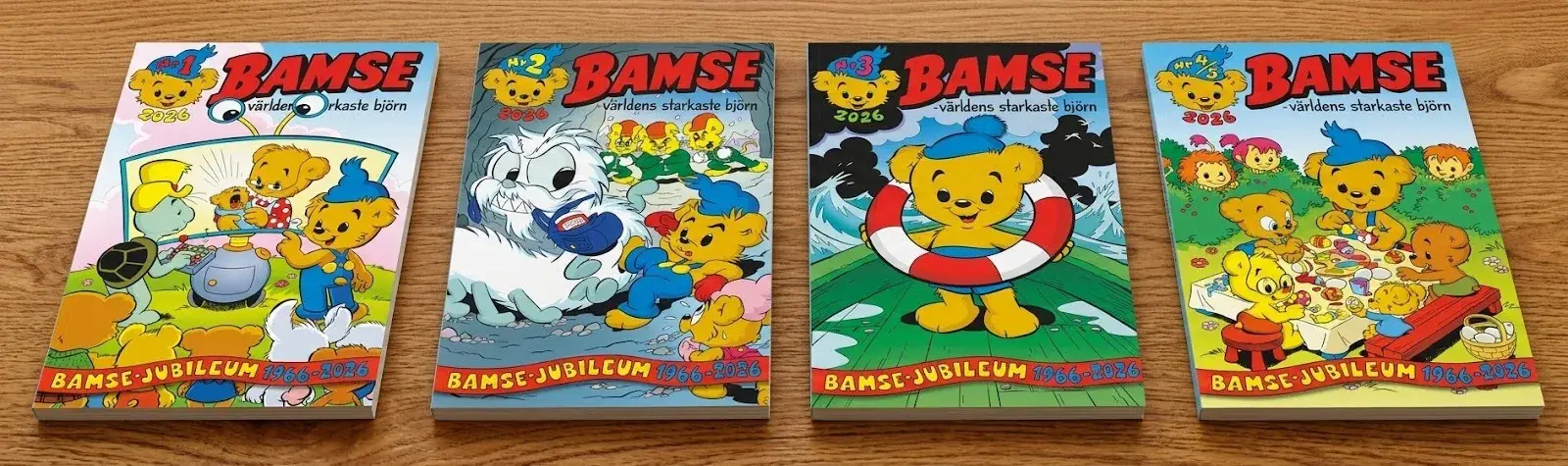
Bamse officially debuted in 1966 as a weekly comic strip, and that same year, the first six Bamse films were shown on Swedish television. The warm reception given to both the strip and the films encouraged Andréasson to develop a comic book devoted entirely to Bamse and his world. Toward the end of the decade, he brought the strip to a close so that he could concentrate on new films and on launching the comic book, whose first issue appeared in January 1973. Bamse’s comic book remains remarkably popular to this day, with 45 issues published each year. Over the decades, Bamse has become much more than a successful comic character. He has grown into a lasting cultural reference point, recognized across generations in Sweden.
Thunder Honey and True Heroism
Bamse is usually described as the world’s strongest bear, and his legendary strength comes from a special honey called dunderhonung, or thunder honey, made by his grandmother. When he eats it, he becomes extraordinarily strong. Without it, he is simply an ordinary bear.
This playful fantasy element gives the stories their magical touch, but it is not the real reason Bamse has remained so loved. His deeper appeal lies in the way he uses his power. Bamse is brave, warm-hearted, and always ready to help. He protects the vulnerable, stands up to injustice, and tries to make the world a better place. In that sense, he represents a distinctly Swedish kind of heroism, calm, thoughtful, responsible, and guided by conscience.
Many beloved children’s characters across cultures use their powers to protect others and stand up for what is right. This is precisely why they are loved. Bamse belongs to that larger tradition of protective and generous heroes. Yet what makes him distinctive is something quieter. His stories place unusual emphasis not only on courage, but also on everyday fairness, emotional intelligence, and the responsibility that comes with being strong.

Why Bamse Matters in Swedish Culture
To understand Bamse is to understand something essential about Swedish children’s culture, which has long placed a strong value on empathy, equality, and social responsibility. His stories carry everyday messages about friendship, solidarity, anti-bullying, inclusion, and care for nature and animals.
That is one reason Bamse occupies such a unique place in Sweden. He is not merely a character children enjoy. He is also part of a wider shared memory. Many adults who grew up with Bamse still feel deep affection for him, not only because of nostalgia, but because of the values his stories conveyed. He belongs to children, certainly, but he also belongs to Sweden’s collective cultural identity.
For visitors, this makes him especially worth noticing. He may seem at first like a small and local reference, but he reveals something real and lasting about the country.
The Characters Who Bring Bamse’s World to Life
Part of Bamse’s enduring popularity comes from the memorable group of characters around him. Together, they create a world that feels adventurous, playful, and emotionally intelligent.
Bamse is the central figure, good-hearted, dependable, and strong when he eats his thunder honey.
Lille Skutt, a rabbit and one of Bamse’s closest friends, is kind but often nervous, which makes him especially relatable and lovable.
Skalman, a clever tortoise, is famous for his inventions and his strict food-and-sleep clock. He often solves problems in unexpected and ingenious ways, and he has become one of the most iconic side characters in Swedish comics.
Wolf, originally one of Bamse’s adversaries, gradually developed into a more nuanced and sympathetic figure. His evolution reflects one of the most interesting aspects of the series, its preference for personal growth, rehabilitation, and understanding over simplistic good-versus-evil formulas.

A Cultural Doorway for Travelers
For travelers interested in Sweden beyond its postcard image, Bamse offers something unusually warm and accessible. He is a cultural reference point that can be encountered in bookstores, toy shops, family spaces, and everyday conversation. For families visiting Sweden, he can be an especially enjoyable point of connection, a familiar and approachable way to engage with local culture through a character who is deeply rooted in Swedish childhood and still warmly recognized across generations.
If you want to explore further and take your tour beyond the city limits, you can visit Bamse’s World at Kolmården Wildlife Park, a large themed area of rides and play zones inspired by the character and his friends, situated a couple of hours south of Stockholm and easily reached by car or public transport.
Not Just for Kids
Although Bamse is undeniably a children’s character, he is not only for children. That is precisely what makes him so interesting. In Sweden, Bamse is one of those rare figures who remain beloved long after childhood. He is remembered with affection because his stories convey a distinctive sense of kindness, fairness, and gentleness that many people value.
As Bamse’s 60th anniversary in 2026 brings new artwork, celebrations, and renewed attention, this is an especially good time to get acquainted with him. Bamse is far more than a comic-book bear. He offers a gentle, enjoyable, and deeply meaningful way to draw closer to the heart of Sweden.
“Bamse is far more than a comic-book bear. He offers a gentle, enjoyable, and deeply meaningful way to draw closer to the heart of Sweden.”
Sources
Official and primary references used to verify dates, schedules, opening information, and other details that can change: