Written by Sara Bulgheroni
Founder and guide at Stockholm Private Guide
Written
At a Glance
On Thursday, April 30, 2026, the historic university town of Uppsala will transform for Valborg, hosting a massive, city-wide celebration of spring that features homemade river rafts, choral singing, and one of Sweden’s largest public festivals.
Why Valborg in Uppsala Feels So Different
If you tend to picture Sweden as a perpetually quiet and reserved country, you have likely never been to Uppsala on the last day of April. While the rest of the country celebrates Valborgsmässoafton (Walpurgis Night) with cozy neighborhood bonfires and gentle choir music, Uppsala takes a decidedly different approach.
Located just a short train ride north of Stockholm, Uppsala is one of Scandinavia’s oldest university towns. Here, Valborg is not just an evening event; it is an all-day, city-wide celebration.
For an international visitor, experiencing Valborg in Uppsala offers a fascinating, high-energy immersion into a side of Swedish culture that rarely makes it into standard guidebooks.
Here is exactly what to expect from the festivities, the traditions, and the crowds as we look ahead to Valborg 2026.
The Morning: "Forsränningen" (The Great River Rafting)
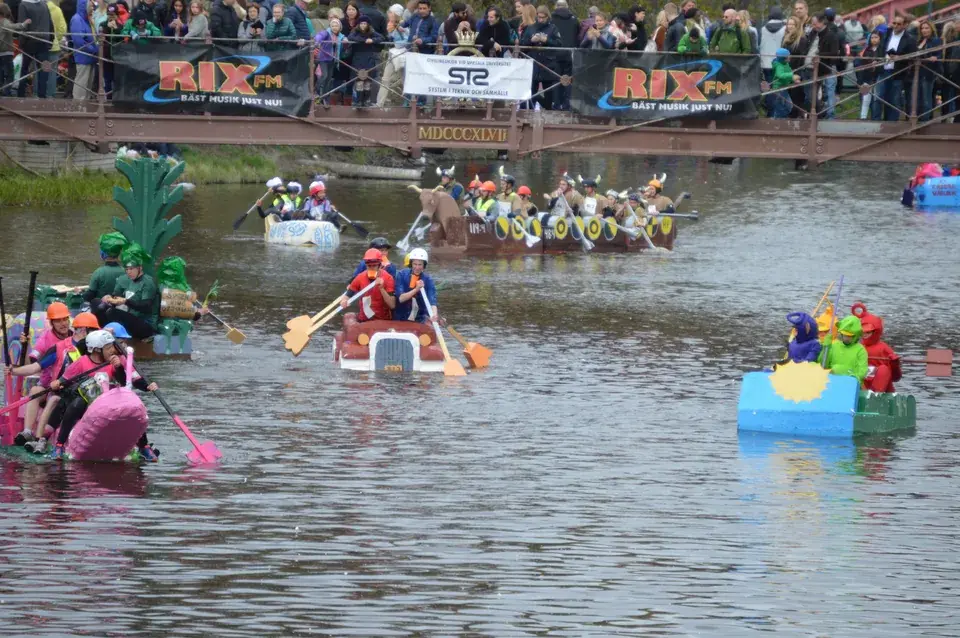
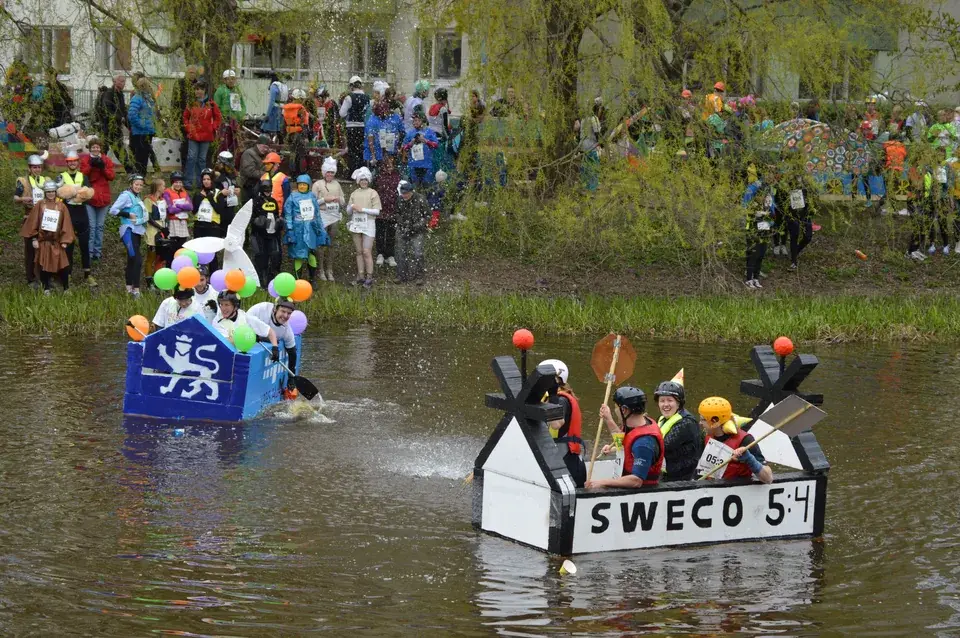
The day kicks off with a uniquely Uppsala tradition that draws tens of thousands of spectators to the banks of the Fyris River. Starting at 10:00 AM, engineering students navigate the chilly, rushing rapids in homemade, brightly painted rafts. This tradition began in 1975 and is still organized by the Uppsala Union of Engineering and Science Students, but it has long since grown into a major public spectacle. This is one of the most entertaining parts of the day: inventive, messy, and extremely funny.
The rafts are built out of styrofoam, wood, and pure optimism. They are shaped like everything from pirate ships and dragons to floating living rooms, and the participants fully commit to the bit with elaborate costumes. Because the rafts are not always structurally sound, half the fun for the crowd is watching the inevitable, freezing-cold capsizes as the students ride down the small waterfalls in the city center.
Late Morning and Early Afternoon: Lunch, Parks, and the Festival Atmosphere
After the rafting, the celebration spreads across the city. Traditional herring lunches are a classic part of Valborg, and Ekonomikum Park becomes one of the main gathering places. It fills up with picnics, friends, and that unmistakable feeling that the whole city has decided to welcome spring at once. This is one of the best parts of Valborg for visitors because you do not need a student connection to enjoy it. You can simply follow the crowds, find a place to sit on the grass, and let the day happen around you.
The Afternoon: "Mösspåtagning" (The Donning of the Caps)
If there is one iconic image of Valborg in Uppsala, it happens at exactly 3:00 PM outside Carolina Rediviva, the university library perched at the top of Drottninggatan.
By mid-afternoon, the steep street is completely packed with tens of thousands of people. As the clock strikes three, the Vice-Chancellor of Uppsala University steps out onto the library balcony and waves a white student cap. In perfect unison, the massive crowd below waves back and dons their own white, sailor-style caps (studentmössor). It is a striking visual representation of winter officially ending and spring beginning.
Following the donning of the caps, the crowd immediately turns and rushes down the hill. This marks the start of the Champagnegalopp (Champagne Gallop), a legendary tradition where students crowd into their respective "nations" (historic student societies) to spray champagne, dance to live music, and celebrate until evening.
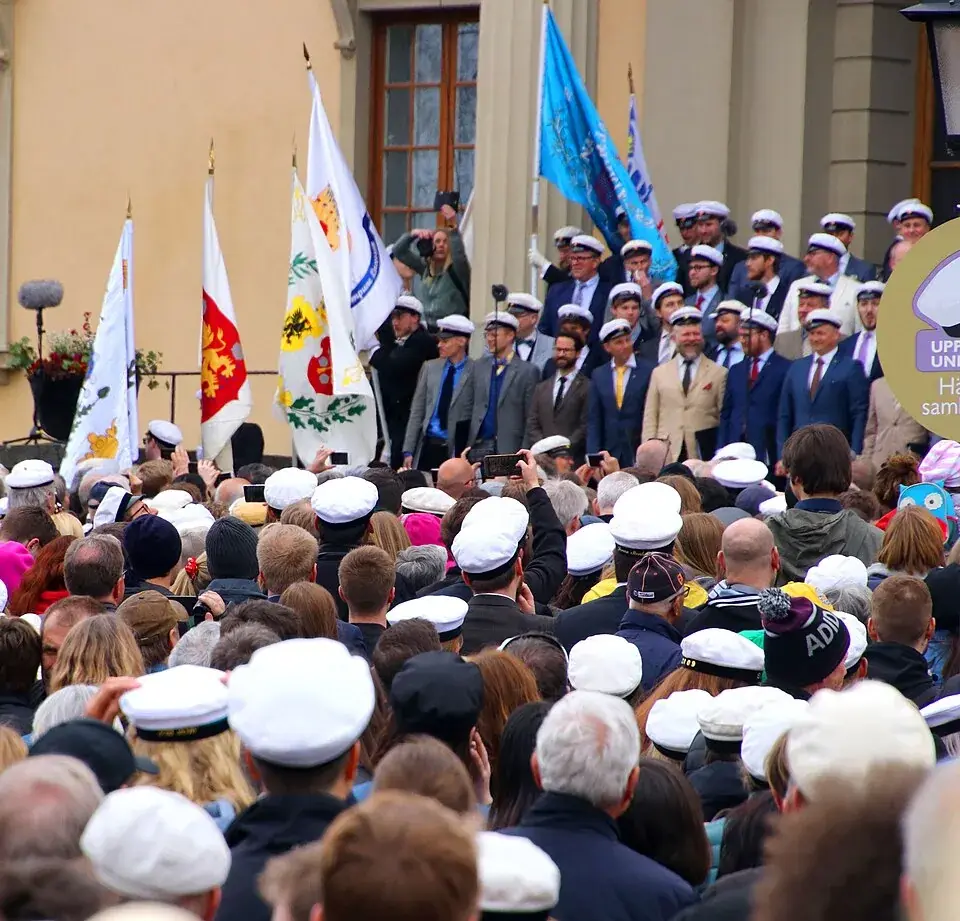
Gaining Access to the "Nations": Entry into these historic student societies requires a special guest card usually reserved for university students. However, the vibrant, festival-like atmosphere spills out into the city’s parks and streets for everyone to enjoy.
The Evening: Bonfires and Choirs
After a chaotic and joyful day, the evening settles into a more traditional Swedish rhythm.
As dusk falls, crowds make their way up to the historic Gunilla Bell (Gunillaklockan) at Uppsala Castle (Uppsala slott). Here, the atmosphere shifts from a loud street party to something much more atmospheric. Traditional bonfires are lit, the bell rings out over the city, and elite university choirs perform melancholic, beautiful spring hymns.
While many gather outside for the bonfires and singing, others dress up to attend the castle's Walpurgis Ball, an elegant ticketed event open to the public for those aged 18 and over.
Planning for Valborg 2026 in Uppsala
In 2026, Valborg falls on a Thursday. As the following day (May 1) is a public holiday, you can expect the crowds to be particularly large, enthusiastic, and ready for a long weekend.
If you are planning to visit, here are a few practical notes to ensure a smooth trip:
Take the Train: Do not attempt to drive into Uppsala on April 30. SJ, Mälartåg, and SL commuter trains from Stockholm take around 40 minutes and drop you off right in the city center. Once you arrive, most of the main celebration areas are close enough to reach on foot.
Trains run on modified schedules during Valborg and on May 1, so it is smart to check your last journey home in advance.
Arrive Early: If you want a good viewing spot along the river for the morning rafting, you will need to claim your space by 9:00 AM.
Embrace the Crowds: Uppsala’s population effectively doubles on Valborg. The parks will be full of picnic blankets, music, and celebrating students. Bring comfortable walking shoes, pack a warm layer for the evening, and be prepared for a beautifully chaotic environment.
Treat the day as a city-wide celebration rather than a single attraction. That is really the charm of Valborg in Uppsala: it is not a performance you stand and watch from the sidelines. For one day, the whole city becomes a celebration.
Experiencing Valborg in Uppsala is unlike anything else in Scandinavia. It beautifully bridges the gap between dignified, centuries-old academic traditions and modern, joyful exuberance.
“For one day, the whole city becomes a celebration.”
Sources
Official and primary references used to verify dates, schedules, opening information, and other details that can change: